

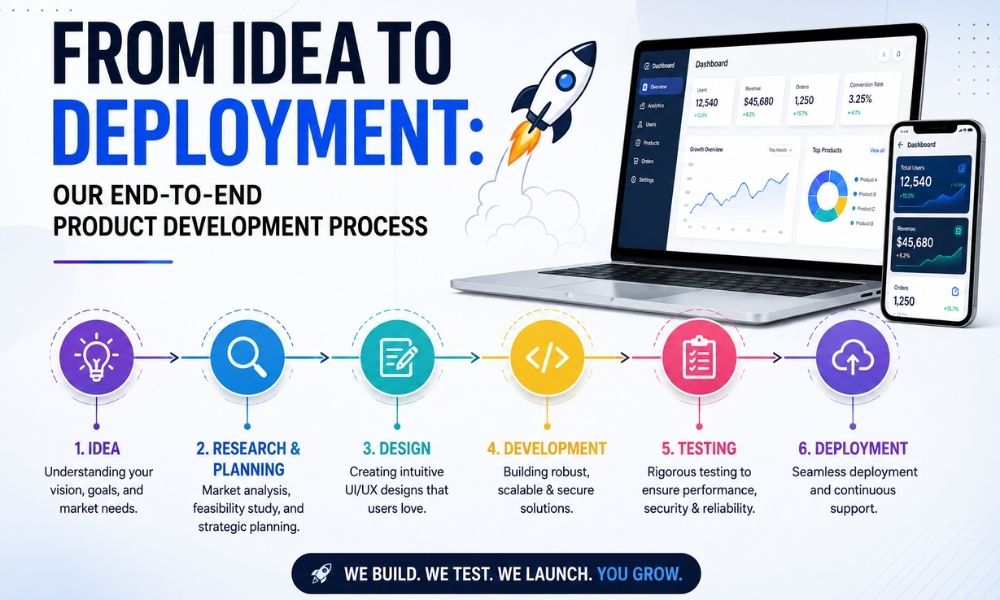
Turning a raw idea into a fully functional, market-ready product is rarely a straight line. It’s a journey that blends strategy, design, engineering, and continuous iteration. Whether you’re a startup founder with a game-changing concept or an enterprise looking to modernize your digital offerings, understanding the product development lifecycle can help you set realistic expectations, avoid costly mistakes, and ship products that actually solve real problems.
In this guide, we walk through every stage of a proven, end-to-end product development process, from the first spark of an idea to a fully deployed, production-ready solution.
Why a Structured Product Development Process Matters
Many product failures don’t happen because of bad ideas; they happen because of poor execution. Skipping discovery, rushing design, or deploying without proper testing can lead to:
• Wasted budgets on features nobody wants
• Missed deadlines due to unclear requirements
• Poor user adoption from clunky UX
• Security vulnerabilities and technical debt
• Costly post-launch fixes
A well-defined process minimizes these risks by ensuring every stage builds on validated insights from the one before it.
Stage 1: Discovery and Ideation
Every successful product starts with a clear understanding of the problem it’s solving. During this stage, the focus is on research, not code.
Key activities include:
• Market and competitor research to identify gaps and opportunities
• Stakeholder interviews to align business goals with user needs
• User personas and journey mapping to understand who you’re building for
• Feasibility analysis covering technical, financial, and operational constraints
• Defining success metrics (KPIs) upfront so progress can be measured objectively
The output of this stage is typically a product vision document, a prioritized feature list, and a rough project roadmap.
Stage 2: Planning and Strategy
Once the idea is validated, it’s time to translate it into an actionable plan.
This stage covers:
• Defining the minimum viable product (MVP) scope
• Choosing the right technology stack based on scalability, budget, and timeline
• Creating a project roadmap with milestones and sprint cycles
• Estimating resources, timelines, and budgets
• Setting up agile workflows (Scrum or Kanban) for iterative delivery
A solid plan at this stage prevents scope creep later and keeps every team member, from developers to designers to stakeholders, aligned on priorities.
Stage 3: UI/UX Design
Design is where the product starts becoming tangible. This stage focuses on how users will interact with the product and how intuitive that experience feels.
Key deliverables:
• Wireframes to map out layout and structure
• Interactive prototypes for early usability testing
• High-fidelity UI designs aligned with brand guidelines
• Design systems to ensure consistency across the product
• Usability testing with real or representative users to catch friction points early
Good design isn’t just about aesthetics; it directly impacts user retention, conversion rates, and overall product success.
Stage 4: Development
This is where the product truly comes to life. Development is typically broken into two parallel tracks:
• Frontend development: building the interfaces users interact with
• Backend development: building the servers, databases, and APIs that power the product
Best practices during this stage:
• Following agile sprints for incremental, testable progress
• Maintaining clean, documented, and scalable code
• Using version control (like Git) for collaboration and rollback safety
• Conducting code reviews to maintain quality standards
• Integrating CI/CD pipelines early to streamline future deployments
Regular demos and check-ins during development ensure the product stays aligned with the original vision, and give stakeholders a chance to course-correct before launch.
Stage 5: Quality Assurance and Testing
No product should go live without rigorous testing. This stage protects both the user experience and the business reputation.
Types of testing include:
• Functional testing to verify features work as intended
• Performance testing to ensure the product handles real-world load
• Security testing to identify and patch vulnerabilities
• Cross-browser and cross-device testing for consistent experiences
• User acceptance testing (UAT) to confirm the product meets business requirements
A dedicated QA phase catches issues before they reach end users, saving significant time and cost compared to post-launch fixes.
Stage 6: Deployment
Deployment marks the transition from a project to a live product. But launching isn’t just about flipping a switch; it requires careful planning.
Key deployment activities:
• Setting up production environments and cloud infrastructure
• Running final smoke tests before going live
• Implementing monitoring and logging tools to track performance
• Planning a phased or full-scale rollout depending on risk tolerance
• Preparing rollback strategies in case issues arise
A smooth deployment process ensures minimal downtime and a positive first impression for users.
Stage 7: Post-Launch Support and Continuous Improvement
Product development doesn’t end at launch, it evolves. The most successful products are the ones that keep listening to users and adapting.
Ongoing activities include:
• Monitoring analytics and user behavior to identify improvement areas
• Collecting user feedback through surveys, reviews, and support tickets
• Releasing regular updates and bug fixes
• Scaling infrastructure as the user base grows
• Planning future feature roadmaps based on real usage data
This continuous feedback loop is what separates a product that stagnates from one that grows and stays competitive.
Key Takeaways
Building a successful digital product requires more than just good code; it demands a structured process that spans research, design, development, testing, and ongoing iteration. Each stage builds on the insights of the last, reducing risk and increasing the odds of building something users genuinely want.
If you’re looking for a technology partner who understands this end-to-end process and can guide your idea from concept to a fully deployed, scalable product, Techffodils brings the strategic thinking, design expertise, and engineering discipline needed to bring your vision to life.