

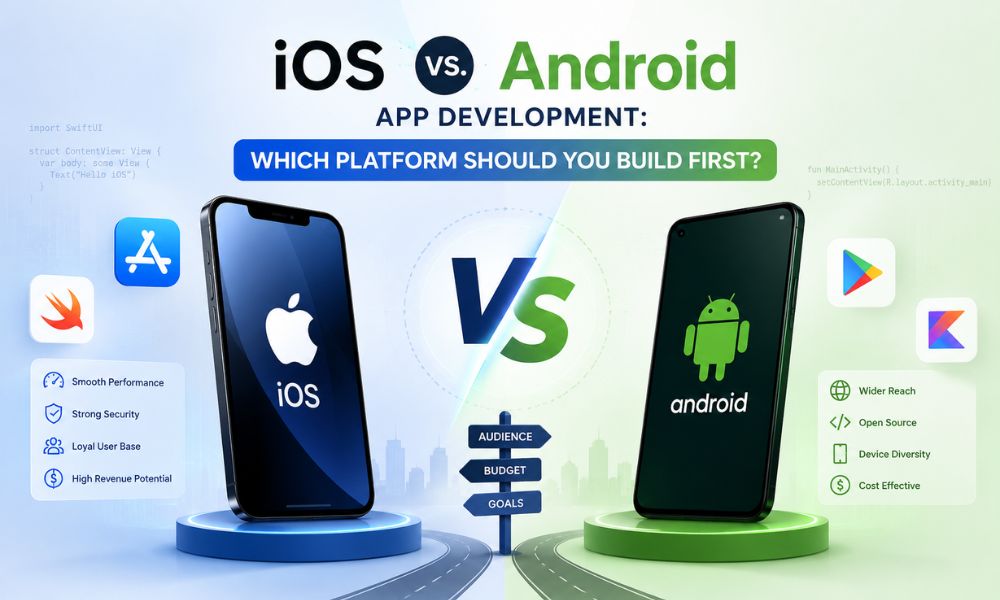
Launching a mobile application is one of the smartest business decisions in today’s digital-first world. Whether you are a startup founder, entrepreneur, or enterprise business owner, mobile apps help improve customer engagement, brand visibility, and revenue generation.
However, one of the biggest questions businesses face at the beginning of app development is:
Should you build your app for iOS or Android first?
Both platforms dominate the global mobile ecosystem, but choosing the right starting point depends on your business goals, audience, budget, and long-term strategy.
This guide breaks down the key differences between iOS and Android app development to help you decide which platform to prioritize in 2026.
Understanding the Mobile App Market in 2026
Before choosing a platform, it’s important to understand market dynamics.
- Android holds the largest global market share due to device affordability and wide manufacturer adoption.
- iOS dominates premium markets with higher user spending and stronger brand loyalty.
Your decision should not be based on popularity alone, it should align with your target audience and business objectives.
iOS App Development: Key Advantages
1. Higher Revenue Potential
iOS users generally spend more on apps, subscriptions, and in-app purchases. Businesses focused on monetization often launch on iOS first because users are more willing to pay for premium experiences.
This makes iOS ideal for:
- Subscription-based apps
- SaaS platforms
- Premium service applications
- Lifestyle and productivity apps
2. Better Performance Optimization
Apple devices operate within a controlled ecosystem. Since Apple manufactures both hardware and software, developers face fewer device variations.
Benefits include:
- Faster development cycles
- Easier performance optimization
- Reduced testing complexity
- Stable app performance
For startups with limited development time, this consistency can be a major advantage.
3. Strong Security and Privacy Standards
Apple emphasizes user privacy and security. Apps must pass strict App Store guidelines before approval.
While approval can take time, it builds user trust and enhances brand credibility.
4. Faster Development and Maintenance
Because there are fewer device models and screen sizes, iOS apps often require less development effort compared to Android.
This can reduce initial development costs and simplify ongoing maintenance.
Android App Development: Key Advantages
1. Massive Global Reach
Android powers billions of devices worldwide, especially across Asia, Africa, and emerging markets.
If your goal is maximum user acquisition, Android is often the first choice.
Android works best for:
- E-commerce platforms
- Social networking apps
- On-demand service apps
- Mass-market consumer applications
2. Wider Device Accessibility
Android apps run on smartphones, tablets, TVs, wearables, and even automotive systems.
This flexibility allows businesses to reach users across multiple device categories.
3. Flexible App Publishing Process
Google Play Store approval is generally faster and less restrictive than Apple’s App Store process.
Advantages include:
- Faster app launches
- Easier updates
- Quick iteration cycles
- Faster testing of new features
For startups experimenting with product-market fit, this flexibility is extremely valuable.
4. Customization Opportunities
Android offers developers greater freedom in design and system integration.
Businesses needing custom workflows, hardware integrations, or unique user experiences may benefit from Android-first development.
Key Factors to Consider Before Choosing a Platform
Instead of asking which platform is better, businesses should ask:
Which platform is better for my audience and business model?
Here are the most important decision factors.
1. Target Audience Location
Choose iOS first if your audience is primarily in:
- United States
- Canada
- Western Europe
- Australia
- High-income urban markets
Choose Android first if targeting:
- India
- Southeast Asia
- Middle East
- Africa
- Emerging markets
Audience geography often determines success more than technical features.
2. Budget and Development Timeline
If you have limited resources:
- iOS development may require less testing effort.
- Android development may demand more optimization across devices.
Many startups launch on one platform first to validate the idea before expanding.
3. App Monetization Strategy
Your revenue model plays a major role.
Choose iOS first if you rely on:
- Paid downloads
- Subscriptions
- Premium services
Choose Android first if you depend on:
- Advertising revenue
- Large user volume
- Freemium models
4. Time-to-Market Strategy
Startups aiming for quick validation often prioritize one platform to test market response.
A focused launch helps gather user feedback, reduce risk, and improve the app before expanding to the second platform.
Should You Build Both Platforms at the Same Time?
Many businesses wonder whether launching both platforms simultaneously is the best approach.
While this sounds ideal, it may not always be practical.
Building both at once means:
- Higher upfront cost
- Longer development timeline
- Increased testing complexity
Instead, many successful companies follow this approach:
- Launch on one platform
- Validate user demand
- Optimize features
- Expand to the second platform
This strategy minimizes risk while maintaining growth potential.
The Rise of Cross-Platform Development
In 2026, cross-platform frameworks like Flutter and React Native are becoming increasingly popular.
These technologies allow developers to build apps for both iOS and Android using a single codebase.
Benefits include:
- Reduced development cost
- Faster deployment
- Consistent user experience
- Easier maintenance
However, native development may still be preferred for high-performance applications such as gaming or advanced enterprise solutions.
Common Mistakes Businesses Make
When choosing between iOS and Android, companies often make these mistakes:
- Choosing based on personal preference instead of market data
- Ignoring target audience behavior
- Underestimating maintenance costs
- Launching both platforms without validation
- Focusing only on development cost rather than long-term ROI
A strategic platform decision ensures sustainable growth.
Final Thoughts
There is no universal answer to whether iOS or Android should come first. The right decision depends on your business goals, audience demographics, monetization strategy, and scalability plans.
For some businesses, iOS offers faster monetization and controlled performance. For others, Android delivers broader reach and rapid user acquisition.
The smartest approach is to treat mobile app development as a phased strategy, launch where your audience is strongest, learn from real users, and expand strategically.
Working with experienced mobile development partners such as Techffodils can help businesses evaluate platform priorities, design scalable applications, and build mobile experiences aligned with long-term digital growth.