

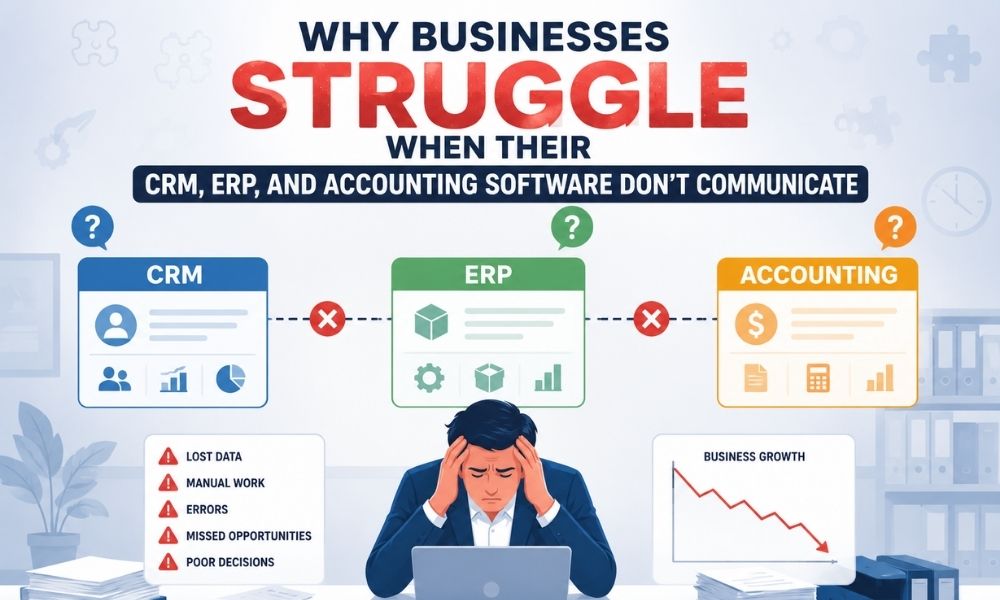
Most growing businesses don’t fail because they lack the right tools. They fail because the tools they already own don’t talk to each other. A sales team closes a deal in the CRM. The finance team invoices from the accounting platform. Operations tracks inventory and fulfillment in the ERP. On paper, each system does its job well. In practice, they operate like three departments that never attend the same meeting.
This disconnect is one of the most underestimated sources of lost revenue, wasted hours, and poor decision-making in modern business. Here’s why it happens, what it costs, and how to fix it.
The Silent Cost of Disconnected Systems
When a CRM, ERP, and accounting software run in isolation, data doesn’t move; people do. Someone has to manually re-enter customer details, chase down invoice statuses, or reconcile numbers that should have matched automatically. Multiply that across every deal, order, and invoice, and you get a business quietly bleeding time and money.
1. Duplicate and Inconsistent Data
Without integration, the same customer might exist as three different records: one in the CRM, one in the ERP, and one in the accounting system, each with slightly different details. Sales sees one version of the truth, finance sees another, and nobody fully trusts the numbers.
2. Delayed and Error-Prone Reporting
When data has to be manually exported, cleaned, and merged before a report can be built, decisions get made on outdated information. A sales forecast that doesn’t reflect real-time inventory or a revenue report that excludes pending invoices isn’t just inconvenient; it’s misleading.
3. Broken Customer Experience
Imagine a customer places a repeat order, but the sales rep has no visibility into unpaid invoices sitting in accounting, or the support team can’t see that a shipment is delayed in the ERP. Disconnected systems create disconnected conversations, and customers notice.
4. Wasted Manual Labor
Employees end up doing the job software was supposed to eliminate: copying data between spreadsheets, cross-checking numbers, and fixing avoidable errors. This isn’t just inefficient; it’s demoralizing for teams who could be doing higher-value work.
5. Poor Financial Visibility
Leadership needs a single, accurate view of sales pipeline, operational costs, and financial health to make good decisions. When CRM, ERP, and accounting data live in silos, that single view simply doesn’t exist, and strategic decisions get made on guesswork instead of facts.
Why This Keeps Happening
Most businesses don’t set out to build disconnected systems. It happens gradually:
• Tools are adopted in phases. A CRM gets implemented first, an accounting tool comes later, and an ERP is added when operations outgrow spreadsheets, with no integration plan tying them together from the start.
• Different departments choose different vendors. Sales picks a CRM that fits their workflow, finance picks accounting software that fits compliance needs, and nobody evaluates how well the two will work together.
• Integration is treated as a “later” problem. Businesses focus on getting each system running individually and assume connecting them can happen “once things settle down.” It rarely does.
• Custom integrations are expensive and fragile. Without the right technical partner, integrations are often built as quick patches that break with every software update.
What a Truly Connected System Looks Like
When CRM, ERP, and accounting software are properly integrated, information flows automatically and in real time:
• A new deal closed in the CRM automatically triggers order creation in the ERP.
• Invoices generated in accounting reflect real inventory and fulfillment status.
• Customer payment history is visible to sales without a single manual lookup.
• Leadership gets one dashboard with sales, operations, and financial data instead of three separate reports that need reconciling.
The result isn’t just efficiency. It’s confidence: in the data, in the numbers, and in the decisions built on top of them.
How to Fix the Disconnect
1. Audit your current stack. Identify every place data is duplicated, manually transferred, or inconsistent across systems.
2. Prioritize integration over addition. Before buying another tool, invest in connecting the ones you already have.
3. Use middleware or API-based integration. Modern integration platforms and custom APIs can sync CRM, ERP, and accounting software without forcing you to replace any of them.
4. Automate recurring data flows. Order creation, invoicing, inventory updates, and customer records should sync automatically, not manually.
5. Work with a technology partner who understands both business processes and software architecture. Integration isn’t just a technical task; it requires understanding how sales, operations, and finance actually work together.
Final Thoughts
Disconnected CRM, ERP, and accounting systems don’t just create technical debt; they create business risk. Inaccurate data, slow reporting, and manual busywork compound over time, making it harder to scale, harder to serve customers well, and harder to trust your own numbers.
The good news is that this is a solvable problem. With the right integration strategy, businesses can turn three separate systems into one connected source of truth and finally get the full value out of the software they’ve already invested in.
If your business is struggling with disconnected systems and wants a technology partner to build seamless integrations between your CRM, ERP, and accounting software, Techffodils can help design and implement a solution tailored to how your teams actually work.