
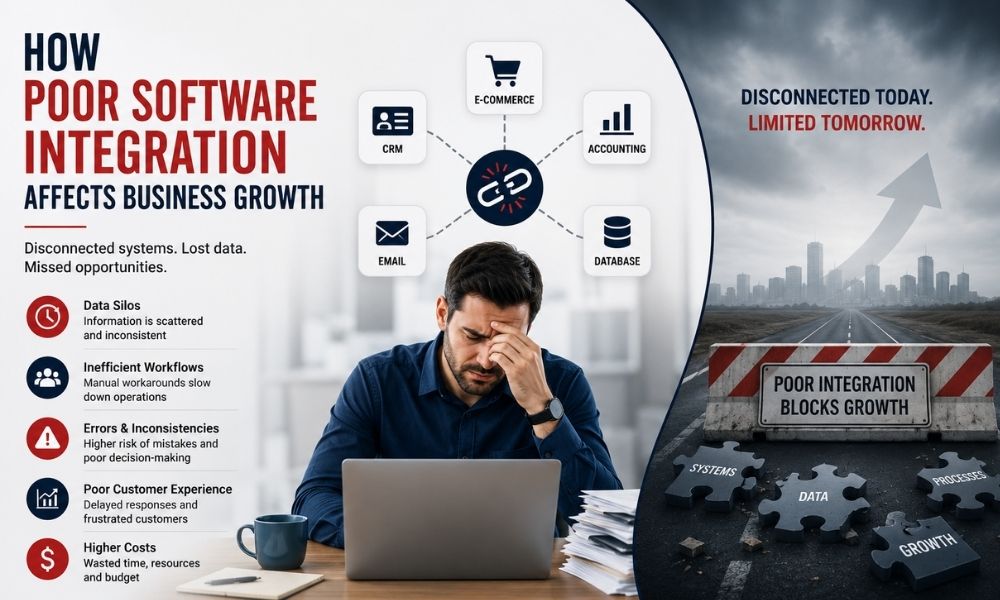
In today’s digital-first economy, businesses rely on a growing stack of software tools, including CRMs, ERPs, accounting platforms, marketing automation, and HR systems. When these tools work together seamlessly, they create a powerful, connected ecosystem that drives efficiency and growth. But when software integration is poorly planned or executed, it can silently sabotage productivity, customer experience, and long-term profitability.
Many organizations underestimate the ripple effects of disconnected systems until the damage is already visible in missed deadlines, frustrated employees, and dissatisfied customers. Let’s explore how poor software integration affects business growth and why getting it right matters more than ever.
1. Data Silos Kill Decision-Making
When systems don’t communicate with each other, data ends up trapped in isolated silos. Your sales team might be working with outdated customer information because the CRM isn’t syncing properly with the marketing platform. Finance teams may struggle to get real-time numbers because accounting software isn’t linked to inventory or sales systems.
Without a single source of truth, leadership ends up making critical business decisions based on incomplete or inconsistent data. This significantly slows down strategic planning and increases the risk of costly mistakes.
2. Reduced Operational Efficiency
Poor integration often forces employees to manually transfer data between systems, copying information from one platform to another, re-entering the same data multiple times, or reconciling mismatched records. This not only wastes valuable working hours but also increases the likelihood of human error.
Over time, these inefficiencies compound. What should take minutes ends up taking hours, and what should be automated becomes a repetitive manual burden. This directly impacts productivity and prevents teams from focusing on higher-value, growth-oriented tasks.
3. Poor Customer Experience
Modern customers expect fast, personalized, and consistent experiences across every touchpoint. When your systems aren’t properly integrated, customer data becomes fragmented; support teams may not have visibility into a customer’s purchase history, or sales reps may not know about an ongoing support ticket.
This disconnect leads to slower response times, repetitive questions, and inconsistent service, all of which damage customer trust. In a competitive market, even small friction points can push customers toward competitors who offer a smoother, more connected experience.
4. Missed Growth Opportunities
Scalability is one of the biggest casualties of poor software integration. As a business grows, it needs systems that can expand and adapt without breaking existing workflows. Disconnected or poorly integrated software creates bottlenecks that make scaling difficult.
For example, launching a new product line, entering a new market, or onboarding a large batch of new customers can become a logistical nightmare if your systems aren’t built to handle increased data flow and process automation. Businesses often end up rejecting growth opportunities simply because their technology infrastructure can’t support them.
5. Increased Operational Costs
While businesses often integrate multiple tools to save money and improve efficiency, poor integration can actually increase costs. Redundant data entry, manual error correction, extended employee hours, and the need for temporary workarounds all add up. Additionally, businesses may end up paying for multiple software licenses that aren’t being used to their full potential simply because the tools don’t work well together.
In the long run, the cost of poor integration far outweighs the investment required to implement a properly connected software ecosystem.
6. Security and Compliance Risks
Fragmented systems are harder to monitor and secure. When data moves between platforms through manual processes or outdated APIs, it creates vulnerabilities that can be exploited. Poor integration also makes it difficult to maintain consistent data governance and compliance standards, especially for businesses operating in regulated industries like finance, healthcare, or e-commerce.
A single security gap caused by disjointed systems can lead to data breaches, regulatory penalties, and reputational damage, all of which can severely hinder business growth.
7. Employee Frustration and Burnout
Employees who constantly battle inefficient, disconnected systems often experience frustration and reduced job satisfaction. Repetitive manual tasks, unclear data, and constant troubleshooting take a toll on morale. This can lead to higher turnover rates, increased training costs, and a loss of institutional knowledge, all of which slow down business growth.
The Way Forward: Invest in Smart Integration
The good news is that these challenges are entirely avoidable with the right approach. Businesses need to invest in well-architected software ecosystems where systems are designed to communicate seamlessly through APIs, middleware, and modern integration platforms. This requires not just technical expertise, but a deep understanding of business processes and long-term scalability needs.
Choosing the right technology partner is critical. A skilled software development team can assess your existing infrastructure, identify integration gaps, and build custom solutions that unify your systems, enabling smoother workflows, better data visibility, and a foundation for sustainable growth.
Conclusion
Poor software integration isn’t just a technical inconvenience, it’s a growth-limiting business risk. From data silos and inefficiency to poor customer experience and security vulnerabilities, the consequences touch every part of an organization. Businesses that prioritize seamless, well-planned software integration position themselves for faster decision-making, better customer relationships, and scalable growth.
If your business is struggling with disconnected systems and inefficient workflows, it’s time to partner with experts who understand both technology and business strategy. Techffofils, the best software development company in Calicut, specializes in building robust, scalable, and seamlessly integrated software solutions that help businesses eliminate inefficiencies and unlock their full growth potential.