
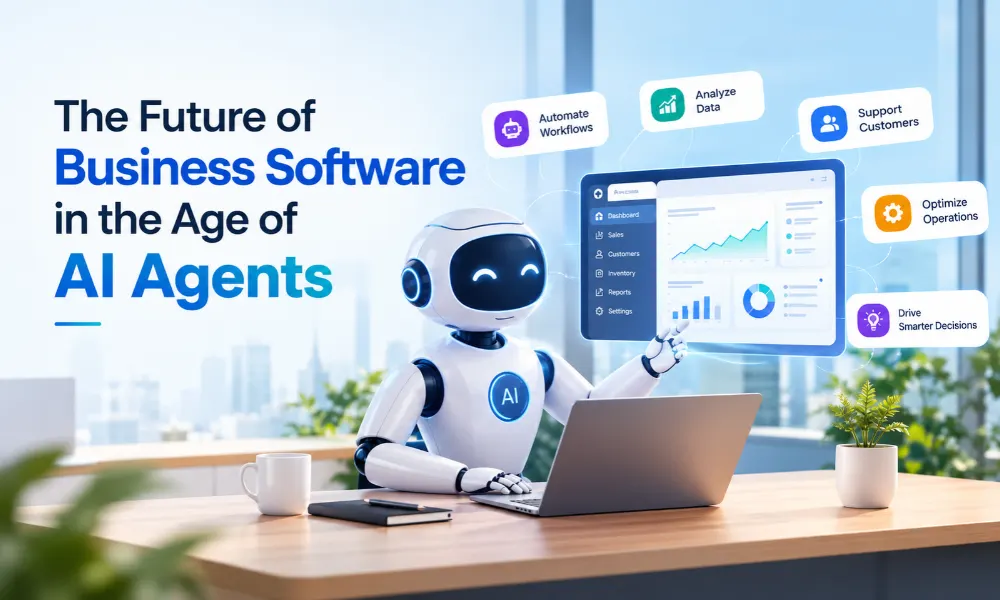
For the last two decades, business software has followed a simple pattern: humans click, type, and approve, while the software waits patiently for instructions. That pattern is breaking down. A new generation of AI agents, systems that can reason, plan, and act across multiple tools without step-by-step human direction, is beginning to reshape what “business software” even means. Instead of static dashboards and rigid workflows, companies are moving toward software that thinks alongside them, and in some cases, acts on their behalf.
From Static Tools to Autonomous Collaborators
Traditional SaaS platforms were built around forms, buttons, and predefined workflows. You told the software exactly what you wanted, and it did that one thing. AI agents flip this model. Instead of a user manually pulling reports, updating spreadsheets, and sending follow-up emails, an agent can be given a goal, such as “close out this month’s invoicing” or “prepare a competitor analysis,” and independently break that goal into steps, pull data from multiple systems, and complete the task with minimal supervision.
This shift means software is no longer just a passive tool sitting in the background. It is becoming an active participant in daily operations, capable of making decisions within defined boundaries and escalating only when human judgment is truly needed.
Why This Shift Matters for Businesses
• Efficiency at scale: Agents can handle repetitive, multi-step processes (data entry, reporting, customer follow-ups) far faster than manual workflows, freeing employees for higher-value work.
• Cross-platform integration: Instead of juggling ten different tools, an AI agent can act as the connective layer, moving information between CRMs, ERPs, communication platforms, and analytics tools seamlessly.
• Personalized decision support: Agents can learn business-specific context over time, offering recommendations tailored to a company’s actual data rather than generic best practices.
• Lower operational overhead: Tasks that once required dedicated staff hours can now run in the background, reducing bottlenecks and turnaround time.
Key Trends Shaping the Next Generation of Business Software
Agentic workflows replacing rigid automation. Traditional automation (like simple “if this, then that” rules) is giving way to flexible, goal-oriented agents that can adapt when conditions change mid-process.
Composable, API-first ecosystems. For agents to be useful, software needs to be built with open APIs and modular architecture, allowing agents to plug into multiple systems rather than being locked into one platform.
Human-in-the-loop governance. Businesses are not handing over full control blindly. The most successful implementations keep humans in the loop for approvals, exceptions, and strategic decisions, while agents handle execution.
Vertical-specific AI agents. Rather than one general-purpose assistant, businesses are increasingly adopting specialized agents built for specific functions such as finance, HR, customer support, and DevOps, each trained and configured around the nuances of that domain.
Trust, security, and auditability as core requirements. As agents gain more autonomy, businesses are demanding clear audit trails, permission controls, and explainability, so every automated action can be traced and verified.
Challenges on the Road Ahead
The move toward agent-driven software isn’t without friction. Companies must address:
• Data quality and access: Agents are only as good as the data and systems they can reach; fragmented or siloed data undermines their effectiveness.
• Security and compliance risks: Giving software more autonomy raises new questions about access control, especially in regulated industries.
• Change management: Teams need to trust and understand how agents make decisions before they’ll rely on them for critical processes.
• Integration complexity: Legacy systems not designed for API-driven interaction can slow down adoption significantly.
What This Means for the Next Few Years
We’re moving toward a hybrid model where business software isn’t just a set of applications employees use, but a network of AI agents working across those applications with defined autonomy. The businesses that adapt early, rethinking workflows, restructuring data access, and designing for agent-friendly integration, will likely see outsized gains in speed and efficiency compared to those that treat AI agents as an add-on feature.
Business software in the age of AI agents won’t replace human decision-making; it will change where that decision-making happens, shifting from execution-level clicks to strategic oversight. The companies and technology partners that understand this shift early are the ones best positioned to lead in the next phase of digital transformation.
As businesses navigate this transition, working with experienced technology partners becomes essential to building the right infrastructure, integrations, and governance for agent-driven systems. Techffodils is one such technology partner helping organizations prepare for this AI-agent-driven future.